
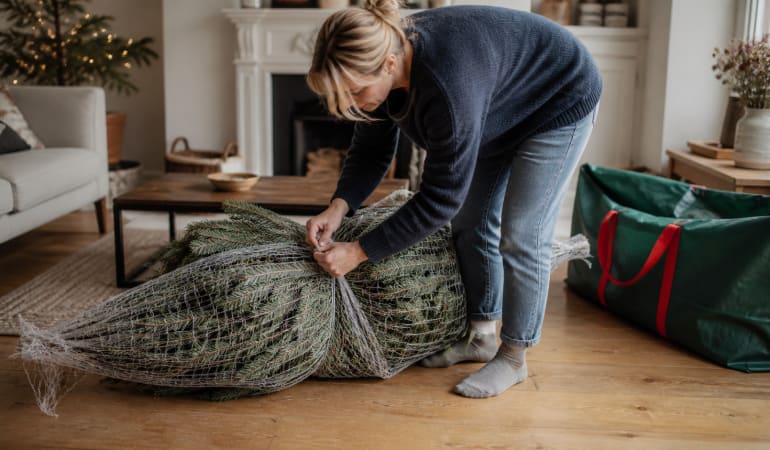
The decorations are down, the tinsel is packed away, and now you’re standing in the living room staring at your artificial Christmas tree wondering what on earth to do with it for the next eleven months. It’s a moment most of us recognise. And if you’ve ever pulled a tree out of storage only to find it looking flattened, bent, or with half its lights refusing to work, you’ll know exactly why proper storage matters.
Knowing how to wrap a Christmas tree for storage correctly makes a genuine difference to how it looks when you unpack it next December. Get it wrong and you’re either wrestling with misshapen branches for an hour or heading out to buy a replacement. Neither option is ideal.
This guide walks you through the right way to do it, including how to protect pre-lit trees, what to avoid, and how to keep everything in good shape until the festive season rolls around again.
TL;DR
- Proper storage prevents bent branches, damaged lights, and dusty decorations.
- A dedicated storage bag designed for artificial trees is the most effective solution.
- Wrapping branches section by section helps preserve their original shape.
- Always remove or carefully secure decorations before packing the tree away.
- Cool, dry storage conditions extend the lifespan of both the tree and its built-in lights.
- Damp environments like garages can cause mould, rust, and wire deterioration over time.
- Labelling your storage bag saves you significant time and frustration in December.
Table of Contents
How to Wrap a Christmas Tree for Storage
Wrapping a Christmas tree for storage means collapsing the branches section by section, securing them gently so they hold their shape, and enclosing the whole tree in a protective cover before moving it to a suitable space. For artificial trees, this usually involves working from the top down, folding branches inward, and using either the original packaging or a purpose-made storage bag.
The key thing to understand is that it’s not just about getting the tree into a bag. It’s about how you get it there. Rushing the process, shoving sections in at odd angles, or letting branches fold back against themselves causes the kind of damage that’s hard to undo.
What Are the Steps for Storing Your Christmas Tree Correctly?
The full process runs from stripping the tree of all decorations through to placing it in a sealed, labelled bag in a dry, stable location. Each step matters, skipping one often creates a problem you won’t discover until December. Here’s the full sequence.
How to wrap and store an artificial Christmas tree safely to preserve its shape and protect its lights between seasons.
Remove all decorations and check the lights
Take off every bauble, piece of tinsel, and hanging decoration before you do anything else. For pre-lit trees, run through the lights one final time to check everything works. Note any faulty sections now so you’re not troubleshooting in December. Pack decorations separately in clearly labelled boxes.
Dismantle the tree into its sections
Most artificial trees come apart into two or three sections. Take them apart carefully rather than forcing them. Keep the central pole sections together and set each branch layer aside so you can work on them individually. This is much easier than trying to wrangle the whole tree at once.
Fold the branches inward on each section
Starting at the top section and working down, fold each branch tip inward toward the central pole. Work your way around evenly rather than pressing from one side. For pre-lit sections, be especially gentle around wire junctions. The goal is a compact, even shape rather than a tightly squashed one.
Wrap each section loosely in a breathable cover
Once a section is folded, wrap it loosely in a breathable material such as a muslin cloth or an old cotton sheet. This stops branches snagging on each other or on the bag, and allows any trapped air or minor moisture to escape during storage. Avoid wrapping tightly.
Place sections into a dedicated storage bag
A purpose-made Christmas tree storage bag is the best option here. Stand the bag upright and load the sections in, starting with the largest base section and working upward. If the bag has internal ties or dividers, use them. Zip it up fully and check the handles are secure before moving it.
Store upright in a cool, dry location
Store the bag upright wherever possible to prevent unnecessary pressure on branches. A cupboard under the stairs, a dry utility room, or a climate-stable loft space all work well. Avoid damp garages, areas next to external walls prone to condensation, or anywhere that gets very warm in summer.
Check also:
Why Does Proper Storage Matter for Your Christmas Tree?
Careless storage is the most common reason artificial trees end up looking tired, patchy, or broken well before their time. A good artificial tree costs a fair amount, and the expectation is that it’ll last for many years. But that only holds true if you treat it well during the months it’s not on display.
When branches get compressed under their own weight without any wrapping or support, they lose their shape. The tips splay out at odd angles, gaps appear where foliage should be, and no amount of fluffing in December fully corrects it. On pre-lit trees, the problem compounds quickly. Wires that get bent sharply or tangled can short out, leaving you with sections that simply don’t light up.
There’s also the dust and moisture issue. A tree stored loosely in a damp garage or loft without any cover will collect grime, attract insects, and potentially develop a musty smell. That’s not the festive atmosphere anyone’s going for when they unpack in late November.
The short version: storing your tree properly costs you very little time. Replacing it costs considerably more money.
How Do You Keep Your Tree’s Branches and Decorations in Good Condition?
Maintaining branch shape and protecting any built-in decorations comes down to how evenly you compress the tree and how carefully you handle anything attached to it. Even with a good storage routine, there are a few specific things worth doing that make a noticeable difference when you unpack in December.
Keeping branches in good shape
The biggest enemy of branch shape is uneven compression. If you pile sections on top of each other with no wrapping between them, the lower branches take the full weight of the upper sections for months. That leads to flattened tips and a lopsided look that’s hard to correct.
Storing the tree upright rather than on its side helps enormously. If you have to store it horizontally due to space constraints, rotate it halfway through the storage period if you can. It sounds like a small thing, but it genuinely helps distribute any compression more evenly.
Handling pre-lit trees with care
Pre-lit trees need a slightly more careful approach during the folding stage. The wires running through the branches are usually fairly flexible, but they don’t respond well to being bent at the same point repeatedly over many years. Try to vary where you make each fold slightly, rather than always creasing at the exact same spot. Over time, this small habit makes a real difference to how long the wiring holds up.
If any of the wire connectors between sections feel stiff or corroded, a very small amount of electrical contact cleaner can help. Don’t use anything oily or wet. Keep connectors dry and, if possible, cover them with a small piece of cling film just for the storage period to keep dust out of the socket.
Dealing with decorations
The safest approach is always to remove every decoration before storage. Even a small bauble left on a branch creates an uneven pressure point over months, and can scratch or dent nearby branches. Tinsel left on can tangle into the wiring on pre-lit trees, which is a frustrating problem to sort out in December.
If you have non-removable ornaments or ribbon that’s wired into the tree structure, secure these flat against the branches with soft ties before folding. The goal is to make sure nothing sticks out at an angle that will catch or snag during compression.
Thinking about swapping your artificial tree for the real thing this year? If packing, folding and storing it for eleven months sounds like more effort than it’s worth, a real Christmas tree skips all of that. There’s no wrapping, no tangled wiring and no storage space to find in January. With real Christmas tree delivery and installation, a fresh tree is brought to your door and set up in your home, so you can get on with decorating.
Want to keep seasonal items safe year-round?
Let's Get in TouchFor questions about the services we offer visit our main site or you can always call us at 020 3746 0584
What Do You Need to Know About Storing a Pre-Lit Christmas Tree?
Storing a pre-lit Christmas tree without damaging the lights is one of the trickier parts of the whole process. The wiring, connectors, and bulb housings are vulnerable if the tree is compressed carelessly or stored somewhere with fluctuating temperatures. Getting these details right is what separates a tree that works perfectly for a decade from one that starts losing sections after three or four years.
Heat is a particular concern. Loft spaces in older homes can get very warm in summer, and that kind of sustained heat over months can degrade the plastic coating on wiring. It won’t necessarily cause an immediate failure, but it shortens the lifespan of the lights noticeably. If your loft gets very warm, it’s genuinely better to find an alternative spot.
When folding a pre-lit section, work slowly around the circumference. If you feel resistance when folding a branch, stop and check whether a wire is caught. Forcing it past resistance is how wire insulation gets nicked or a bulb housing gets cracked.
The connectors between sections deserve specific attention. These are usually the first thing to fail on a pre-lit tree. Keep them clean and dry, check them gently before storage, and if any pins look bent, straighten them carefully before the tree goes away. Trying to fix a bent connector after it’s been under compression for a year is significantly harder.
If you’re looking for somewhere to keep larger seasonal items long-term, a storage service provides a good environment where your belongings stay at a stable temperature year-round, away from the damp and heat extremes that cause the most damage over time.
Check also:
What Are the Most Common Mistakes When Storing a Christmas Tree?
The most common mistakes when storing a Christmas tree are skipping the wrapping step entirely, storing the tree in a damp or very warm environment, leaving decorations on during storage, and using non-breathable plastic bags that trap moisture against the branches and wiring. Each of these shortens the tree’s lifespan and makes setup harder the following year.
Here’s a closer look at where things tend to go wrong, and what to do instead.
- Storing without wrapping: Loose sections bouncing around inside a bag damage branch tips and tangle wiring. Always fold and wrap before bagging.
- Using a damp garage or shed: Moisture gets into wiring, corrodes connectors, and can cause mould on the branch fibres. Use a dry interior space instead.
- Leaving baubles or tinsel on the tree: These create pressure points and tangle into wiring during storage. Remove everything before you fold a single branch.
- Compressing too tightly: A storage bag that you’ve had to sit on to close is too full. Tight compression deforms branches permanently and stresses wire insulation.
- Storing horizontally under heavy items: Weight from above flattens the lower sections. Store upright, or at the very least make sure nothing sits on top of the bag.
- Ignoring the original packaging: If you still have the box the tree came in, it’s often the best storage option. It’s sized correctly and usually has dividers that keep sections separate.
- Not labelling the bag: You will not remember which end is which in eleven months. A simple label on the outside saves real time and frustration in December.
Check also:
Frequently Asked Questions
Can I leave decorations on my Christmas tree during storage?
It’s best not to. Even lightweight baubles create pressure points against branches during storage, and items like tinsel can work their way into wiring on pre-lit trees. Over months, this causes dents in branch tips, tangled wires, and scratched surfaces. Taking everything off before storage adds perhaps twenty minutes but saves a lot of hassle the following year.
How should I clean my tree before storing it?
A quick once-over with a soft dry cloth or a handheld vacuum on a low setting removes most of the dust and loose debris that accumulates during the season. For pre-lit trees, avoid any moisture near the wiring. If the branches have developed an odour, a lightly scented sachet placed inside the storage bag will help without any contact with the tree itself.
Is it okay to store my Christmas tree in the attic?
It depends on the attic. A boarded, insulated loft with reasonable temperature stability is generally fine. An uninsulated roof space that hits high temperatures in summer and near-freezing in winter is not ideal, particularly for pre-lit trees, as extreme temperature swings degrade wire insulation and can weaken plastic branch joints over time. If your loft gets very warm, consider a ground-floor storage space instead.
What’s the best way to label my storage bag for quick identification?
Write clearly on a luggage tag or tie-on label and attach it to the handle. Include the tree’s height, the number of sections, and which end is the top. If you have a multi-tree household or store other seasonal items nearby, a brief contents note on the outside of the bag saves significant time when December arrives and you’re pulling boxes out in a hurry.
Find the right storage solution for your home this season.
Enter your postcode to view our rates and availability in your area.
For questions about the services we offer visit our main site or you can always call us at 020 3746 0584
Conclusion
Knowing how to wrap a Christmas tree for storage properly is one of those small things that pays off significantly over time. A tree that’s stored well for ten years looks almost as good as it did on day one. One that’s been shoved in a bag without any care tends to look noticeably worse each season until it’s no longer worth putting up.
Follow the steps in this guide, take an extra few minutes with the branch folding and wrapping, and choose your storage location carefully. Your future self, standing in the living room in December with a perfectly shaped tree, will appreciate the effort.