You’ve got a mirror you love. Maybe it’s the big one in the hallway, or the vintage piece above the fireplace that took ages to find. Moving day is coming, and you’re already picturing it shattered on the van floor. That sinking feeling is very common, but it’s entirely preventable.
The problem is that most people figure a roll of bubble wrap and a bit of optimism will do the job. It won’t. Knowing how to pack mirrors for moving properly makes the difference between arriving at your new home with everything intact and standing over a pile of broken glass wondering what went wrong.
This guide covers exactly what to do, what to avoid, and what most people forget entirely.
TL;DR
- Bubble wrap alone is not sufficient protection for mirrors during a move
- Mirror-specific boxes offer the best structural protection available
- Corner protectors absorb shocks that bubble wrap simply can’t handle
- Antique and ornately framed mirrors need custom crating and extra padding
- Mirrors should always be loaded upright in the van, never laid flat
- Strapping mirrors securely inside the vehicle prevents dangerous movement in transit
Table of Contents
Is Bubble Wrap Enough to Protect Mirrors When Moving?
No, bubble wrap alone is not enough to protect a mirror during a move. It cushions against surface scratches and minor vibrations, but it offers almost no resistance to impact or pressure. The corners remain exposed, the frame has no structural support, and the whole thing can still flex and crack inside a soft wrapping if something shifts in the van.
Here’s the thing. Bubble wrap has earned a reputation as the ultimate packing material, and for some items it really is ideal. But mirrors aren’t just fragile surfaces. They’re rigid, they have weight, and they’re vulnerable at the edges and corners more than anywhere else. Wrapping a mirror in bubble wrap and calling it done is a bit like putting a crash helmet on a raw egg. It feels thorough. It isn’t.
The false sense of security is the real danger. People spend twenty minutes wrapping their mirror carefully, step back, feel satisfied, and then load it in the van in a way that undoes all that effort. Impact during sudden braking, vibration over uneven roads, or something heavy sliding into it from across the van can all cause breakage that bubble wrap simply can’t prevent on its own.
Bubble wrap is still part of the process. It just can’t be the whole process.
Check also:
How Do You Properly Pack Mirrors for Moving?
Packing a mirror safely comes down to layering protection correctly and using the right materials in the right order. Here’s exactly how to do it.
Step 1: Gather your materials
Before you start, get everything together. You’ll need:
- A mirror box (telescoping boxes are ideal because they adjust to fit different sizes)
- Packing paper or newsprint
- Bubble wrap
- Corner protectors, foam or cardboard
- Strong packing tape
- A permanent marker to label the box
Don’t try to improvise the box. A standard cardboard box is not built for this. Mirror boxes are longer, narrower, and designed to keep the mirror upright and supported. They’re widely available from removal suppliers and they’re worth every penny.
Step 2: Cushion the mirror surface with packing paper
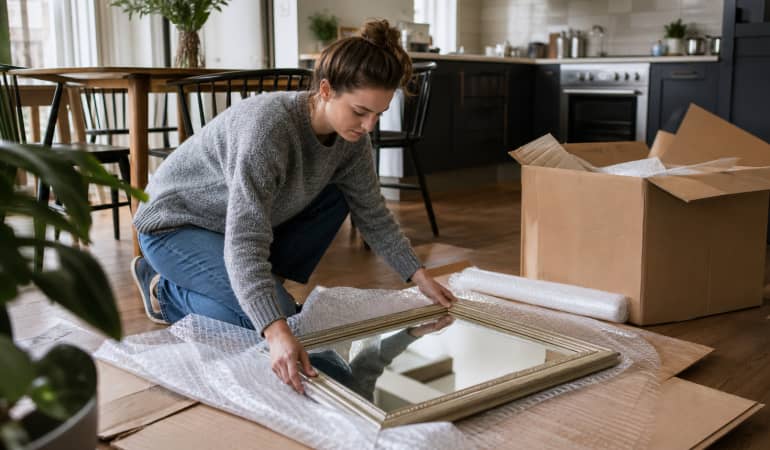
Lay several sheets of packing paper flat and place the mirror face-down on top. Fold the paper up and over the front of the mirror, covering the entire glass surface. This first layer protects against scratches and gives the bubble wrap something to grip. It also stops the bubble wrap’s texture from pressing directly against the glass, which can occasionally leave marks on older mirror surfaces.
Step 3: Apply corner protectors
This is the step most people skip, and it’s arguably the most important. Corners are where impact travels first. Foam corner protectors clip or press onto each corner and absorb the shock that would otherwise go straight through the frame and into the glass. Fit one to each corner before you do anything else with the bubble wrap.
Step 4: Wrap with bubble wrap
Now wrap the entire mirror in bubble wrap, starting from one end and working to the other. Overlap each pass by a few centimetres. Secure it with packing tape, but don’t tape directly onto the frame. If the frame is painted or gilded, tape can lift the finish when removed. Tape only onto the bubble wrap itself.
Step 5: Box it up
Slide the wrapped mirror into the mirror box. If there’s any movement inside, fill the gaps with scrunched packing paper or folded bubble wrap. The mirror should feel snug with no rattling. Seal the box firmly with tape, reinforce the bottom seam, and write “FRAGILE” and “THIS SIDE UP” clearly on both sides in large letters. Don’t assume the removal team will guess.
Need help packing your mirrors safely?
Let's Get in TouchFor questions about the services we offer visit our main site or you can always call us at 020 3746 0584
Special Considerations for Antique and Uniquely Shaped Mirrors
Standard mirrors are straightforward. Antique mirrors and ornately framed pieces are a different challenge entirely, and most guides don’t give them the attention they deserve.
The issue with antique mirrors isn’t just the glass. It’s the frames. Ornate carved wood, gilded plasterwork, and aged lacquer are all fragile in different ways. A knock that a modern mirror frame would shrug off can chip, crack, or splinter an antique one. Unlike a new mirror, you can’t replace what’s lost.
Unusually shaped mirrors, oval, arched, or asymmetric, also create challenges because standard mirror boxes won’t fit them properly. Gaps inside the box mean movement, and movement means damage.
Use custom crates for high-value antiques
For anything genuinely valuable or irreplaceable, a custom wooden crate is the right answer. It’s not cheap, but it provides rigid structural protection that no cardboard box can match. The mirror is padded inside and immobilised completely. If you’re not confident building one yourself, specialist removal companies can organise this for you.
Double-wrap with soft blankets
Before applying bubble wrap, wrap the mirror in a soft moving blanket. This protects delicate frame surfaces from the texture and pressure of bubble wrap, and it adds an extra layer of cushioning. Then wrap over the blanket with bubble wrap as normal.
Add extra padding to ornate frames
Carved or raised details on frames are the first things to break off. Tuck small pieces of foam or folded packing paper into any deep recesses or protruding details before wrapping. It takes a few extra minutes, but those details are almost impossible to repair once they’re gone.
Check also:
Why Are Corner Protectors So Important for Moving Mirrors?
Corner protectors are critical because the corners of a mirror absorb the first and hardest impact in any collision. Even a small knock to a corner can send a stress fracture spreading across the entire glass surface. No amount of bubble wrap compensates for unprotected corners, because bubble wrap compresses rather than absorbs sudden force.
There are a few different types worth knowing about:
- Foam corner protectors: Soft, flexible, and easy to fit. They press onto the corner and stay in place. Good for most standard mirrors and light frames.
- Cardboard corner guards: Stiffer than foam. Better for heavier mirrors where the frame itself needs structural support. You can cut these from spare cardboard in a pinch.
- Moulded plastic protectors: The most rigid option. Useful for very large mirrors or anything travelling over long distances.
To attach them properly, press each protector firmly onto the corner before wrapping. If they feel loose, secure them lightly with a small strip of tape. Then wrap over them so they’re held in position. They need to stay exactly in place during transit, not slide out the first time the van goes over a speed bump.
It’s a simple step. It takes about two minutes. Skip it, and you’re leaving the most vulnerable points of your mirror completely exposed.
Check also:
Packing Techniques for Large or Oversized Mirrors
Large mirrors bring a different set of problems. The bigger the mirror, the more surface area there is to protect, the more weight there is to manage, and the harder it is to fit everything into a standard mirror box. Here’s how to handle them.
Load upright, not flat
This is the single most important rule for oversized mirrors. Stand them upright in the van, on their edge, the way you’d lean them against a wall. When a mirror lies flat, the weight of anything placed nearby creates downward pressure on the glass. It doesn’t take much. Upright loading distributes weight along the frame instead of across the glass surface.
Strap them in
An unsecured mirror, even one standing upright, will shift and slide during transit. Use ratchet straps or moving straps to fix it against the van wall. If you’re using a removal company, point this out to them specifically. A professional packing service brings the right equipment for securing large fragile items and loads the van with this kind of thing in mind from the start.
Surround with soft furnishings
For very large mirrors, use the van’s contents to your advantage. Pack mattresses, sofas, or soft folded rugs against the sides of the mirror. They act as natural buffers and take up the slack if straps have any give. Just make sure nothing with hard edges or metal components is leaning directly against the glass or frame.
Check also:
Transporting Mirrors Safely: Dos and Don’ts
Even a perfectly packed mirror can end up broken if it’s loaded or transported the wrong way. Keep these points in mind when moving day arrives.
Positioning in the Van
✅ Do: Use a removal van with enough space to stand mirrors upright without forcing them against other items.
❌ Don’t: Lay mirrors flat at any point during loading, transit, or unloading.
Securing the Mirror
✅ Do: Secure mirrors to the van wall with proper moving straps before the vehicle moves.
❌ Don’t: Lean mirrors against surfaces without securing them, as one stop can send them sliding.
Labelling
✅ Do: Label every mirror box clearly with “FRAGILE” and “THIS SIDE UP” on both faces.
❌ Don’t: Stack boxes or other items on top of a mirror box, even briefly.
Protection and Handling
✅ Do: Pad the floor of the van with blankets before leaning mirrors against it.
❌ Don’t: Rush the unboxing at the other end; take the same care removing the mirror as you did packing it.
The unpacking stage catches a lot of people off guard. They’ve been careful all day, they’re tired, they’re nearly done, and they get sloppy right at the end. A mirror that survived the whole journey can still break if you pull it out of the box too quickly or prop it somewhere unstable while you figure out where it’s going.
Get your mirrors packed safely and ready to move
Enter your postcode to view our rates and availability in your area.
For questions about the services we offer visit our main site or you can always call us at 020 3746 0584
Conclusion
Knowing how to pack mirrors for moving is one of those things where a bit of effort upfront saves a lot of grief later. The right materials, applied in the right order, aren’t complicated. They just require more than a quick roll of bubble wrap and a hopeful attitude.
Layer your protection, guard the corners, keep it upright, and strap it in. Do those four things and your mirror will almost certainly arrive exactly as it left.