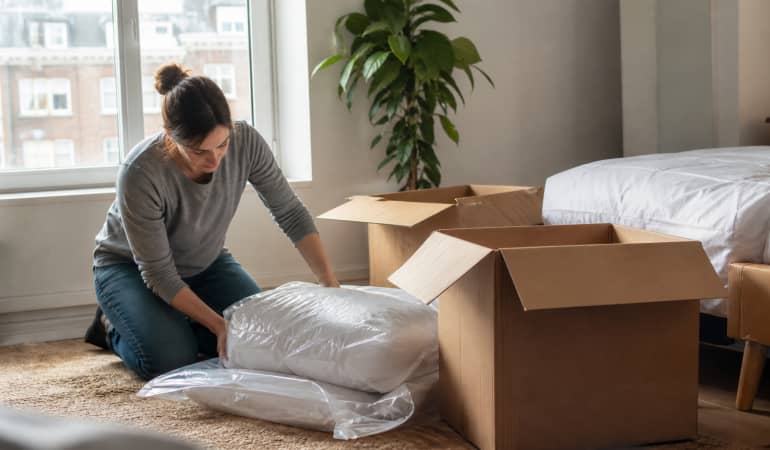
Most people dread packing the kitchen. Or the wardrobes. But bedding? It usually gets shoved into a bag at the last minute, stuffed into whatever space is left in the van, and arrives at the new place creased, damp-smelling, or buried under three boxes of books. It’s one of those jobs that looks simple until you’re standing there holding a king-size duvet with nowhere obvious to put it.
The good news is that knowing how to pack bedding for a move properly makes a real difference. Not just for keeping your sheets in good shape, but for saving space, staying organised, and making sure your first night in a new home doesn’t involve hunting through unlabelled boxes at midnight.
This guide covers everything: the right materials, the smartest methods, how to use your bedding to protect other items, and why a first-night box is worth every minute it takes to put together.
TL;DR
- Wash and fully dry all bedding before you pack it, damp fabric leads to mildew fast.
- Use vacuum storage bags to compress duvets and pillows and save serious van space.
- Choose boxes for fragile or structured items and bags for soft, flexible bedding.
- Label every box clearly, including which room it belongs to and what’s inside.
- Pack a dedicated first-night box with sheets, pillowcases, and a duvet so you can sleep without unpacking everything.
Table of Contents
How to Pack Bedding for a Move
A step-by-step process for packing all types of bedding efficiently and safely before a move.
Wash and fully dry all bedding
Before anything goes into a bag or box, wash every item and make sure it’s completely dry. Even a small amount of residual moisture can cause mildew during transit, especially on longer moves. Don’t rush the drying cycle, if your tumble dryer leaves items slightly damp, air them out for an hour before packing.
Sort bedding by type and priority
Group your bedding into categories: sheets and pillowcases, duvets and heavy blankets, decorative throws, and first-night essentials. Sorting first means you won’t be pulling everything apart later looking for the one set of sheets you need on arrival night. Keep delicate or heirloom pieces separate from everyday items.
Fold or roll sheets and lighter items
Roll fitted sheets and flat sheets tightly to save space and minimise creasing. Pillowcases can be folded flat and slipped inside a matching sheet roll to keep sets together. Lightweight blankets and throws roll well too. Place rolled items upright in a box, like books on a shelf, so they’re easy to see and grab.
Compress duvets and pillows with vacuum bags
Place each duvet or pillow inside a vacuum storage bag, seal the zip fully, and use a hoover to extract the air. For duvets, fold into thirds lengthways before rolling down into the bag. Don’t compress feather-filled items too aggressively, remove enough air to make the bag compact and manageable, not completely flat.
Pack boxes with heavier items at the bottom
If you’re using cardboard boxes, place heavier blankets and folded items at the bottom and lighter rolled sheets on top. Don’t overfill boxes to the point where they can’t close properly or become too heavy to carry safely. A box that’s 80% full and closes cleanly is better than one that’s bursting.
Label every box and bag clearly
Write on each box: what’s inside, which room it belongs to, and whether it contains first-night essentials. Use a thick marker that won’t smudge. Label two sides of the box, not just the top, so you can read it even when boxes are stacked. This one step saves significant time on unpacking day.
Need a hand with packing for your move?
Let's Get in TouchFor questions about the services we offer visit our main site or you can always call us at 020 3746 0584
Compare Your Packing Options
There’s no single best way to pack bedding for a move. The right choice depends on what you’re packing, how much space you’re working with, and how long the journey is. Here’s how the main options stack up.
| Packing Option | Best For | Watch Out For | |
|---|---|---|---|
| Cardboard boxes | Structured packing, stackability, protecting shape | Takes up more space; bulky items don’t compress | |
| Large zip bags / fabric bags | Soft items, pillows, light blankets | Can slide around in the van if not secured | |
| Vacuum storage bags | Duvets, thick blankets, pillows, anything bulky | Seams can fail; feather-filled items need gentle compression | |
| Wardrobe boxes | Delicate quilts or heirlooms you don’t want to fold | Expensive and large; not practical for everyday bedding |
The honest verdict: vacuum storage bags win for space-saving, particularly in a packed removal van where every centimetre counts. Cardboard boxes win for organisation and stackability. Most people will use a combination of both, and that’s genuinely the smartest approach.
One thing worth knowing about vacuum bags: don’t over-compress feather or down-filled duvets. Crushing the fill too aggressively can damage the clusters and reduce the duvet’s ability to trap warmth. Compress enough to make it manageable, not as flat as physically possible.
For delicate or heirloom quilts, skip the vacuum bag entirely. Fold loosely, wrap in acid-free tissue paper if you have it, and place in a box lined with a clean sheet. These items don’t need rough handling.
Check also:
Creating a ‘First-Night’ Bedding Box
A first-night box is exactly what it sounds like: a single box (or bag) packed with everything you need to get through your first evening and morning in the new home, without touching anything else. It’s one of the most practical moving tips there is, and bedding is the most important category to include.
Think about it. You arrive at the new place tired, probably hungry, and surrounded by a sea of boxes. The last thing you want to do is dig through six unlabelled containers searching for your duvet. If you’ve got a clearly marked first-night box sitting at the front of the van, that problem doesn’t exist.
Here’s what to put in it:
- One complete set of bed sheets per bed (fitted sheet, flat sheet or duvet cover, pillowcases)
- One duvet per bed, loosely folded or lightly vacuum-compressed for easy retrieval
- Two pillows per person, don’t underestimate how much a bad night’s sleep affects moving day recovery
- A light throw or blanket in case the heating isn’t sorted yet
- Spare pillowcases (they double as useful padding for fragile items in the same box)
Mark the box clearly on every visible side: “FIRST NIGHT, OPEN ME FIRST.” Load it into the van last so it comes out first. It’s a small thing that makes moving day significantly less stressful.
If you’re not sure how to approach the broader packing process, a professional packing service handles everything from fragile items to bulky bedding, so you’re not left making last-minute decisions about what goes where.
Check also:
Can You Use Bedding as Protective Padding?
Yes, and it’s one of the most practical things you can do during a move. Duvets, blankets, and even thick pillows make excellent padding for fragile items, often better than bubble wrap for certain shapes. This approach saves you money on packing materials and reduces the amount of stuff you need to transport separately.
Here’s how to do it properly:
Mirrors and framed pictures
Lay a duvet flat, place the mirror or frame face-down in the centre, then fold the duvet over and around it. Secure the bundle with tape or packing straps. The soft layers absorb impact from any direction. Stand the wrapped item upright in the van rather than flat, mirrors are more vulnerable to pressure from above than from the side.
Electronics and small appliances
Blankets and thick throws work well wrapped around televisions, monitors, or small kitchen appliances. They won’t replace the original box for screens, but as a secondary layer of protection inside a box or around a wrapped item in the van, they’re genuinely effective. The key is making sure the item can’t slide around inside the wrapping.
Filling gaps in boxes and the van
Rolled blankets and pillows are perfect for filling empty space in boxes where fragile items might otherwise shift during transit. They’re also useful for wedging between furniture items in the van to prevent movement. A shifting wardrobe is one of the most common causes of transit damage, and a few well-placed folded duvets can stop that entirely.
The one rule to keep in mind: don’t use bedding that contains loose feathers or easily shed fibres to wrap anything that has vents or grills, like electronics. Fibres can get inside and cause problems. Use synthetic-fill items for those jobs.
Get your bedding packed properly and ready to move
Enter your postcode to view our rates and availability in your area.
For questions about the services we offer visit our main site or you can always call us at 020 3746 0584
Conclusion
Packing bedding for a move doesn’t need to be stressful, but it does need a bit of thought. Wash everything first, use vacuum bags for the bulky items, mix boxes and bags depending on what you’re packing, and always put together a clearly labelled first-night box. These steps together mean you arrive at a new home ready to sleep comfortably, not still searching for a fitted sheet at eleven o’clock.
The added bonus of using your duvets and blankets as padding for fragile items is worth remembering too. It saves on packing materials, reduces the number of boxes you need, and puts those soft layers to work while they’re being transported anyway. Smart packing isn’t about doing more, it’s about doing it once, doing it right, and not having to redo it when you get there.